I’ve lived on the west coast for more than 30 years now with ample time to thoroughly explore western US and west coast national parks! They will leave you in a state of wonder and awe. From steamy geysers and majestic forests to unusual geological features like rainbow-colored sandstone and towering, narrow slot canyons, these are my favorite places to go!
Note: Many of these parks are located in states along the west coast. All of them are located in the Western U.S.
Before 2026, the National Park Service instituted advance reservation systems to manage overcrowding at many of the most popular parks in the U.S.
However, this year, the Adminsitration has eliminated those in favor of an “open access” policy and real-time “management strategies”. While this may be more convenient for visitors planning stays, the jury is out on what a summer experience might actually be like.
Be prepared for park areas that are closed because they are deemed to be full, traffic jams, understaffing, and strain on resources. My advice? Visit in shoulder season or arrive at the park’s gate as soon as it opens to avoid long lines.
Weekday visits and late afternoon visits are other ideas that may help.
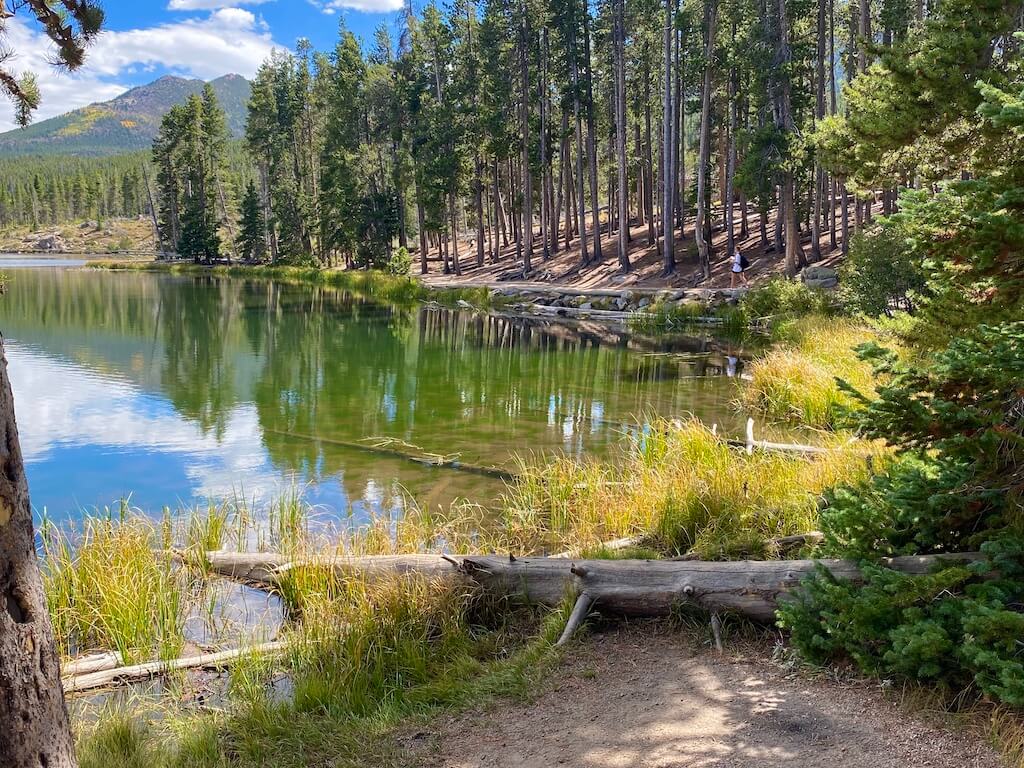
See These National Parks Out West
1. Yellowstone National Park for a World-Famous Geyser
Camping permits and entrance pass required; no advance reservations to enter the park are needed.
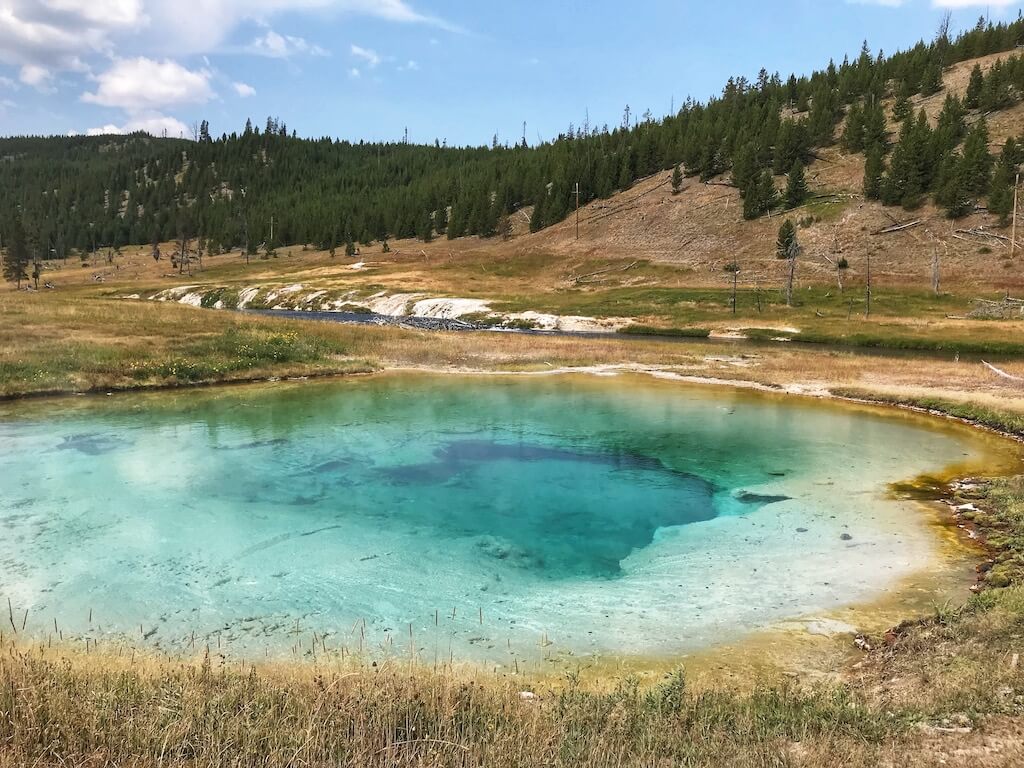
As America’s oldest and perhaps most famous national park, Yellowstone delivers… geothermal hot springs, sparkling rivers, lush valleys, dramatic canyons, and wildlife galore. While it’s not on the actual west coast, it’s in the western US and is definitely one of the all-time best national parks in America.
I took my kids here when they were small and have been back a number of times since. You could spend a lifetime exploring here. Plus, there are dozens of epic hikes in Yellowstone.
Your Yellowstone itinerary should include time visiting geysers and hot springs—Norris Geyser Basin, Grand Prismatic Spring, and Old Faithful—and marveling at the stunning Grand Canyon of the Yellowstone.
(And your national parks packing list should definitely include binoculars!)
Lamar Valley is America’s Serengeti. Wolf packs and bison herds are easily spotted here. Hayden Valley is another great place to see bison.
Just remember that Yellowstone is huge! In fact, it’s got five separate entrances over 3,500 square miles, so be strategic when planning your visit to minimize drive time.
Here is my curated list of the best Yellowstone cabins.
2. Yosemite National Park for Waterfalls and Half Dome
Yosemite will no longer use a timed reservation system for peak season in 2026.
Yosemite National Park is one of the most visited national parks in the country—and for good reason.
Personally, I’ve been here dozens of times since my college days.
Seeing the towering peaks from Yosemite Valley should be on everyone’s bucket list. But Yosemite has more than just great views! You’ll also find epic hikes, backcountry trails, and scenic drives. And it’s a great place to experience fall in California.
Every Yosemite National Park adventure should start in Yosemite Valley. A walk through the valley rewards you with stunning views of Yosemite Falls, Half Dome, and El Capitan.
The best vantage point of Yosemite Valley is from Tunnel View, a popular spot for photographers.
Yosemite has some of the most iconic national park hikes. Strenuous hikes like Cloud’s Rest and Four Mile Trail offer once-in-a-lifetime views.
True adventure seekers should get a permit to hike the cables at Half Dome in the Summer.
The best sunset in the park is from Taft Point. In the late afternoon, hike the moderate loop trail to Sentinel Dome and Taft Point for stunning golden hour views.
If hiking isn’t your thing, take a scenic drive instead! Glacier Point Road and Tioga Pass Road are both incredibly scenic.
For any adventure in Yosemite, book a spot at one of the park’s many campgrounds or lodges to be close to the action. Or stay in your own private cabin!
Check prices and availability on places to stay near Yosemite here.
Julia | Well Planned Journey
Map of Best Western National Parks in the USA
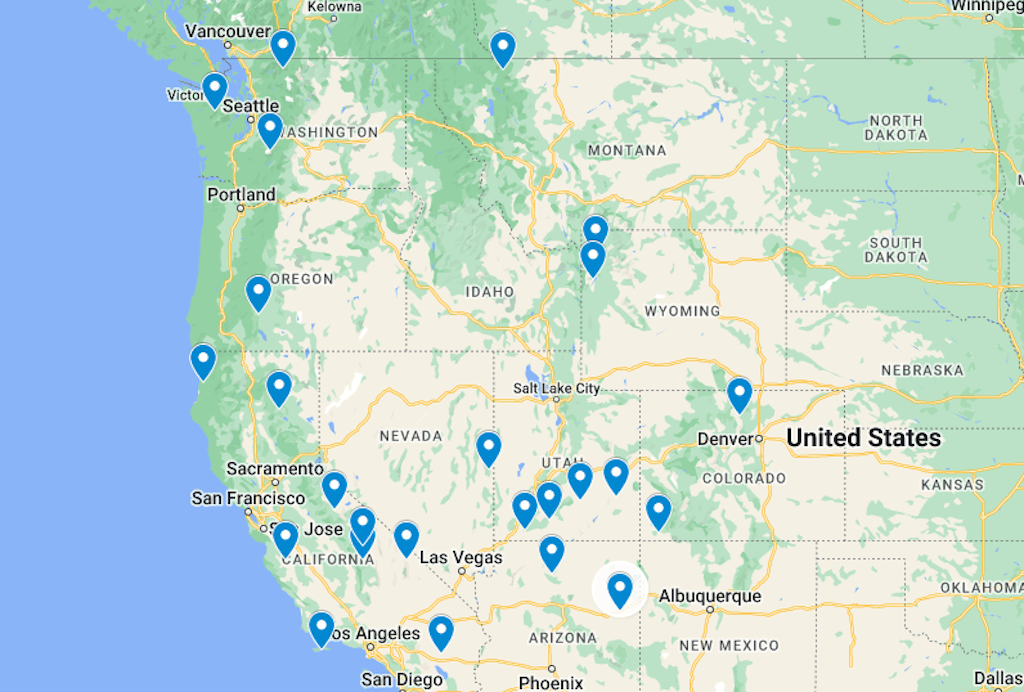
How to use this map: This map is an image. Click the map to open an interactive version of the map. From there, if you click “open in my maps”, you can add this to your Google maps. Just click the tiny transparent star to the right of the map description to save it in “your places.” Go to “your places” next and there it is!
3. Grand Teton National Park for Iconic Mountain Peaks
Grand Teton does not require timed entry or vehicle entrance reservations. Be aware though the lodging inside the park fills a year in advance. Camping is by reservation only.
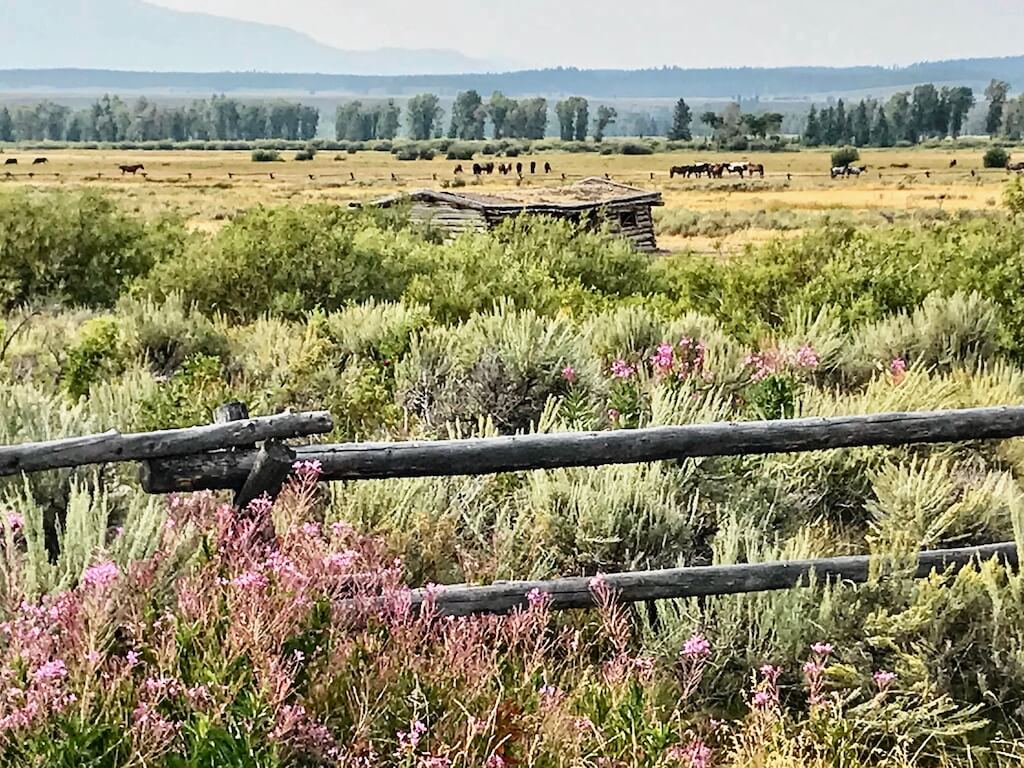
Grant Teton is an amazing story of restoration and nature’s resilience. Once an area of huge cattle ranches and towns, today, this natural treasure is a spectacular national park with towering snow-capped mountains (the Tetons), staircase valleys, rivers, hikes, and astonishingly rich wildlife.
There are so many incredible things to do in Grand Teton. (We combined our visit with one to western Yellowstone.)
While restoring the natural habitat, the park has preserved human history. Old ranchers’ houses, a complete Norman village, ranch fences, and various other displays have preserved some of the evidence of human industry and activities in the area.
These form some amazing props for pictures, as you can see in our picture gallery of Grand Teton National Park.
Along the main Highway 191, there are many trailheads and quick scenic spots.
For me, the most memorable stop was at Schwabacher Landing, where we saw a mama moose with her young ones. They played, ate, and fought in the stream, allowing us to watch and photograph the exhilarating scene for 25 minutes.
I highly recommend the hike up to Taggart Lake. If you have time, continue on to do all three trails. There are so many great hikes in Grand Teton.
Follow the trail up to Lake Taggart which is a 3-mile hike and takes about 2 hours. It passes through forests and meadows with a variety of vegetation and ecosystems, leading up to the quiet and beautiful lake.
And don’t miss Jenny Lake! It’s one of my most favorite little lakes.
Check prices and availability of cabins and other places to stay near Grand Teton here.
Jyoti | Story at Every Corner
4. Zion National Park for Narrow Red Rock Slot Canyons
Zion no longer requires a general entry or timed entry reservation but you must have a permit for hiking Angels Landing and camping reservations. Arrive early. Parking fills fast here!
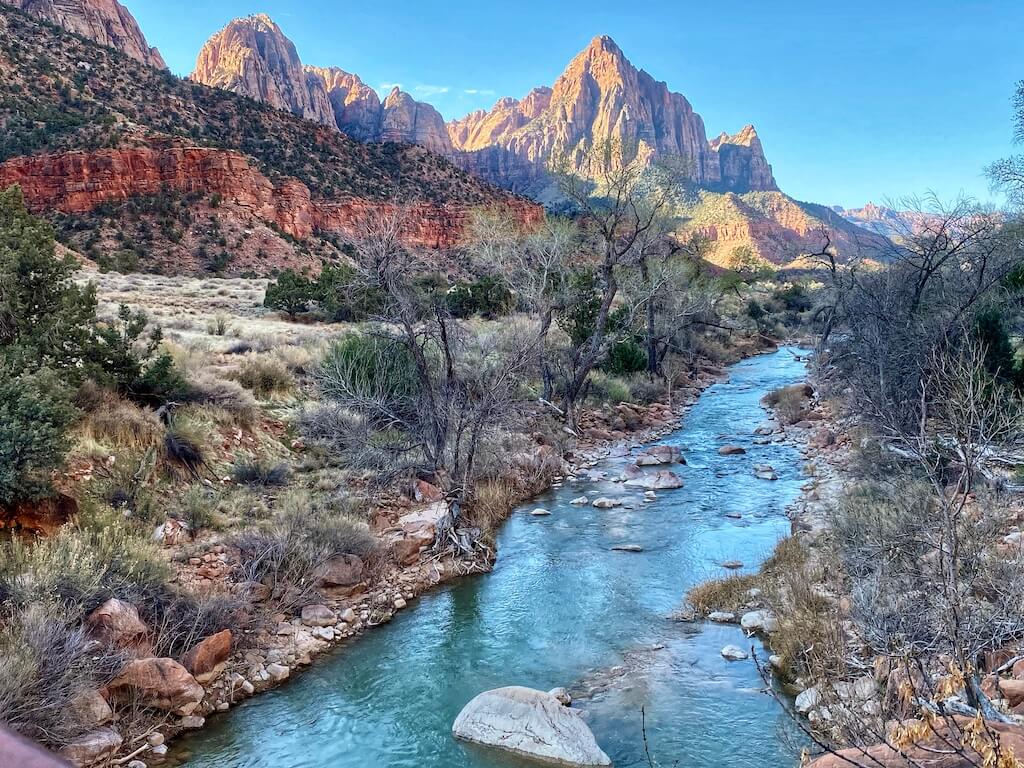
Zion is the crown jewel of Utah’s national parks. It’s filled with sharp peaks, high mesas, rainbow-colored rocks, and twisting canyons.
Follow the same path natives once walked and gaze at the huge sandstone cliffs.
The best way to experience this amazing place is by strapping on your hiking boots and finding your path. Hiking in Zion is amazing. With so many beautiful hikes to choose from, you won’t know where to start.
Inexperienced hikers might try the “Overlook Trail.” It’s a short one mile out and backtrack to see the Great Arch.
Alternatively, add the “The Narrows” slot canyon to your list. This hike varies from 5 to 9.4 miles (depending on how far you want to go). Subject to rainfall, this is also one where you could get wet. Shoes that drain well are recommended.
Adventurers love to hike famous Angel’s Landing. Due to popularity, the park is currently piloting both a seasonal and day-before lottery. You can only hike it if you secure a permit.
Other top tips for Zion: It’s always best to arrive early before the crowds and utilize the shuttle service to get around more easily. Many parts of the park are not accessible by car, so the shuttle is your best bet for getting around. Carry lots of water. Bring a hat and use plenty of sunscreen for protection.
Or rent an ebike as we did! You’ll skip the line of cars at the entrance and enjoy a memorable ride.
The summer months can be very hot in the afternoon, and afternoons may bring thunderstorms and flash flooding. Spring and late fall can be more temperate.
Camping options abound here. All visitors must purchase a recreational pass.
Zion National Park makes an ideal holiday destination. Check prices and availability of cabins and other accommodations near Zion here.
Chris | The Aquarius Traveller
5. Channel Islands National Park for Panoramic Ocean Views
Advance reservations are required for Channel Island for both transportation (Island Packers ferry) and camping. Both sell out so book six months ahead.
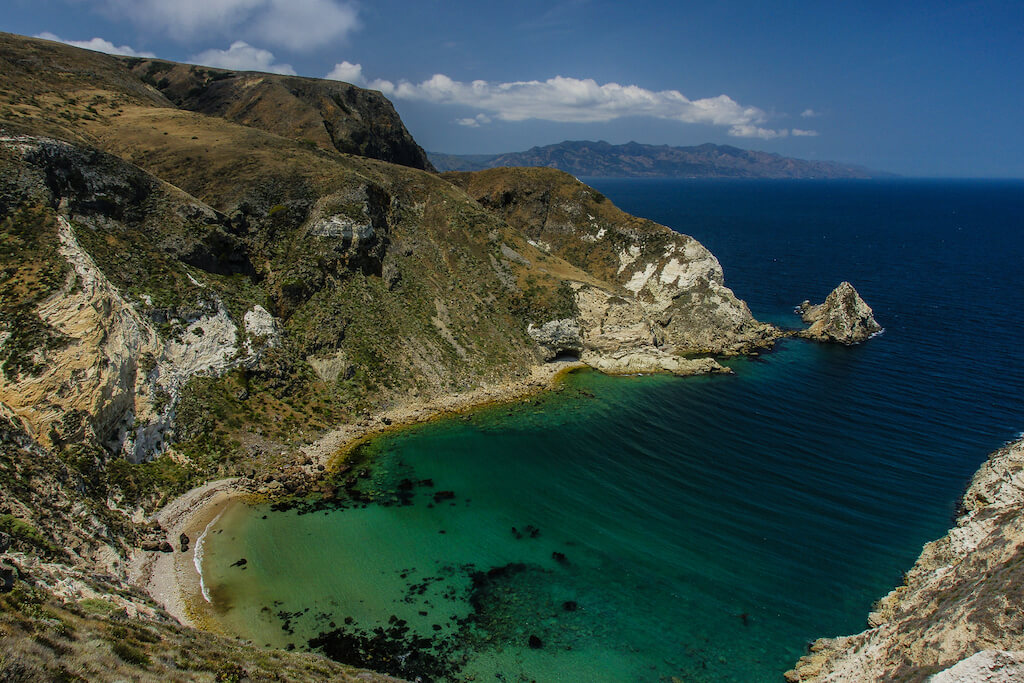
Channel Islands National Park is often overlooked among the national parks on the west coast in favor of more famous parks. There’s no highway to the park. To get here, you need to travel by boat or plane.
While this remoteness makes the park more difficult to access, it also means much smaller crowds. Channel Islands doesn’t offer flashy amenities, but it does offer peace and solitude.
When planning your day trip to the Channel Islands, you’ll want to start with one of the more accessible islands, like Santa Cruz.
It’s about an hour and a half to get here, but the sightseeing starts when you get on the boat. You’ll likely see pods of dolphins and even whales on the way!
Once you arrive, the clear waters offer unparalleled kayaking and snorkeling. Pack a picnic lunch and enjoy your food with a cool ocean breeze at the beach.
On Santa Cruz Island, walk the Navy Road up the hill to get magnificent views, but pack a hat since there’s almost no shade.
The Channel Islands are home to many plant and animal species that you can’t find anywhere else in the world. Keep an eye out for the island fox and the island scrub jay.
Channel Islands National Park offers beautiful California weather year-round and is an ocean lover’s dream. Note: There is no lodging on the islands. Your best bet is to stay on the mainland in nearby Ventura or Santa Barbara.
Santa Barbara is a beautiful spot to base in particular. Check prices and availability of places to stay in Santa Barbara here.
Ale | Sea Salt & Fog
6. Grand Canyon National Park for the Most Famous Canyon in the World
No entry reservations or timed entry permits are required. Advance bookings are required for lodging, camping, and tours.
Located right next to Page, Arizona, the Grand Canyon is one of the most famous canyons in the entire world. (Consider a day trip to Scottsdale while you’re here…or a trip to Sedona for otherworldly beauty.)
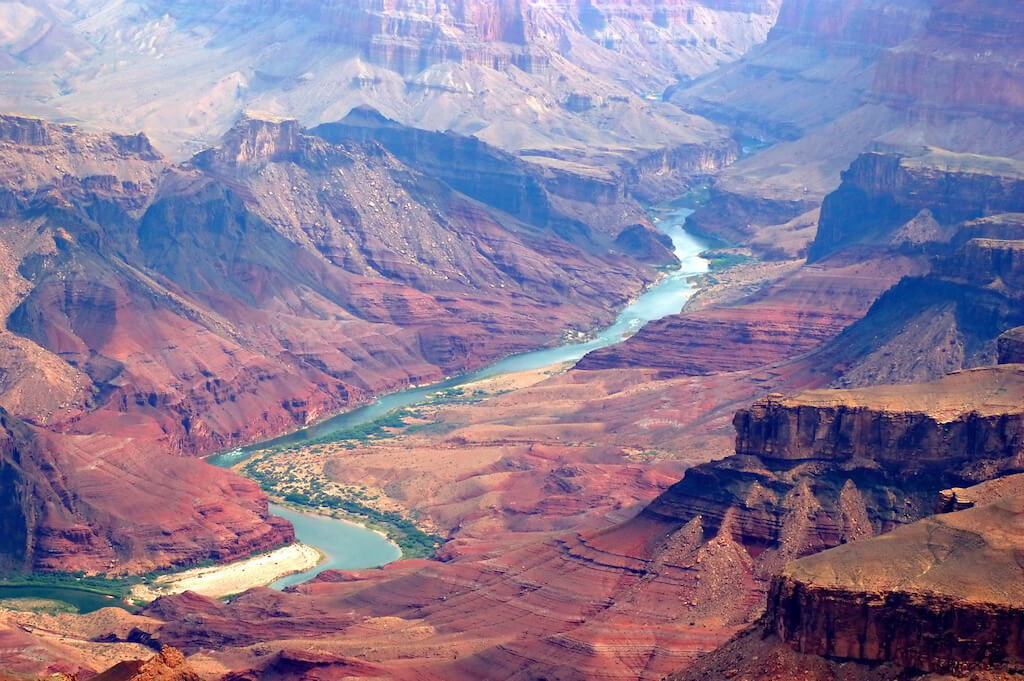
What makes it so special is that this canyon is one of the deepest canyons anywhere, at a staggering 6,000 feet deep at its deepest point. The canyon also stretches about 277 miles wide and offers visitors some of the most splendid views anywhere.
One of the best hikes for incredible views is the Bright Angels Trail. Or if you don’t want to hike, you can ride a mule straight into the Grand Canyon, which is just fantastic!
There’s also a museum on site where you can learn all about the geology and history of the Grand Canyon. It’s a magical place to visit.
Check prices and availability on places to stay near the Grand Canyon here.
Wayne | The Daily Tourist
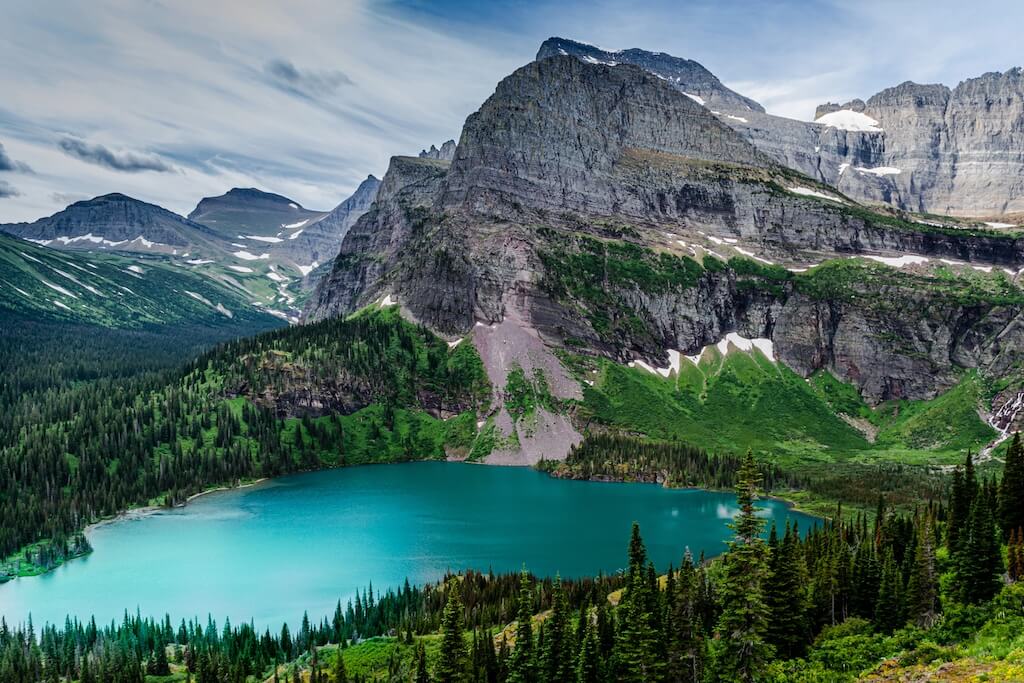
7. Glacier National Park for Glacier-Carved Peaks and Valleys
Glacier has shifted away from its ticketed entry system from prior years. Still, expect temporary short-term closures in busy areas like Many Glacier and Two Medecine.
My first trip to Glacier was 30 years ago en route with a tent and a u-haul trailer when we moved from California to Chicago. And I’ve never forgotten it!
Snow-dusted mountain peaks protrude from the green valleys of one of America’s most dramatic landscapes. Glacier National Park is nothing short of breathtaking.
It’s not just easily accessible scenic vistas that make this park worth visiting. The wildlife and hiking trails are the real allure.
From shorter 4-mile loops and glacial blue lakes (Avalanche Lake) to the adrenaline-pumping cliffside Highline Trail, clocking in at over 11 miles, there are hikes for all comfort levels.
Glacier National Park is also one of the best places in the United States for bear sightings. Both grizzly and black bears live within the park boundaries as well as foxes, mountain goats, eagles, and bighorn sheep.
If you only have a few days to explore Glacier National Park, I recommend driving the “Going-to-the-Sun” road that winds up through peaks in the park and hiking the Highline Trail. It’s one of the most epic American drives there is!
A regular shuttle will take you from the end of Highline Trail back to the parking lot at Logan’s Pass.
This will give you all the best views of the valley and the most opportunities for spotting wildlife.
For those who want to hike the trail early (which you should) to avoid the mid-morning parking nightmare in the park, Logan’s Pass parking lot is a great place to stealth camp in your camper van or even just your car. Just be sure to pack extra blankets.
Check prices and availability of places to stay in Kalispell, near Glacier, here.
Geena | Beyond the Bucket List
8. Petrified Forest National Park for Petroglyphs
Advanced timed-entry reservations are not required at Petrified Forest National Park.
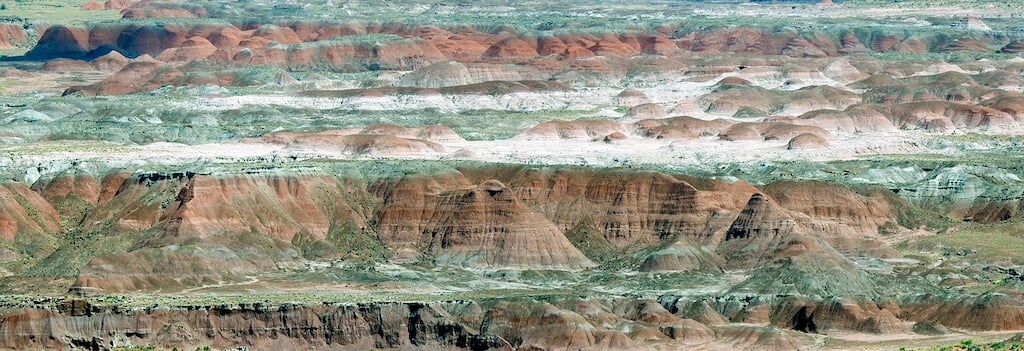
In Northeast Arizona lies a beautiful, unique national park, the Petrified Forest National Park. With its fossils, petroglyphs, and painted desert, I felt like I was in an alternate univers!
The painted desert is a colorful pallet of ever-changing colors—something to gaze at for hours.
The park is famous for its abundance of petrified logs. There are so many found together that they suggest a petrified forest, one of the largest in the world.
Other features of the park are the badlands, wildflowers, and ancient petroglyphs.
The park can be best explored by stopping at the viewpoints and trying some of the walking trails. The viewpoints are along the main road through the park, which is 28 miles long and will take about an hour to drive (without stops).
In addition to the Painted Desert and petrified logs, we stopped along the main road for the exhibit on Route 66 and Newspaper Rock. Newspaper Rock has over 650 petroglyphs!
There are seven walking trails here. To get the best overview of the park, do at least the Painted Desert Rim Trail, Agate House Trail, and Long Logs Trail.
Check prices and availability of places to stay near Petrified Forest here.
Cosette | KarsTravels
Save on your parks visit: Get the America the Beautiful Pass
The America the Beautiful Pass is your ticket to freedom! For $79.99, it gives you a whole year of access to more than 2,000 federal recreation sites, including national parks nationwide.
It covers entrance for a driver and all passengers in a personal vehicle or up to 4 adults at sites that charge per person. When you buy through REI, they donate 10 percent of the sale to the National Park Foundation.
Get your America the Beautiful pass here.
9. Olympic National Park for Rainforest
Olympic National Park does not require advance reservations or timed-entry permits. However, plan on advance bookings for wilderness camping, overnight backpacking, and some campgrounds.
Don’t miss Olympic National Park on the Olympic Peninsula in Washington state. (Also check out Moran State Park on nearby Orcas Island if you’re in this area!)
This gorgeous (and green!) national park spans over 900,000 acres and is one of the most visited US national parks. It’s also one of the most beautiful places to visit in Washington.
Olympic National Park makes a great family vacation destination. There are so many things to do with kids.
It is also renowned for its diverse landscapes, including rainforests, mountains, beaches, and more.
If you travel to Olympic National Park during the summer, everything will be open and accessible. This means the many Olympic National Park hikes are open and ready for visitors.
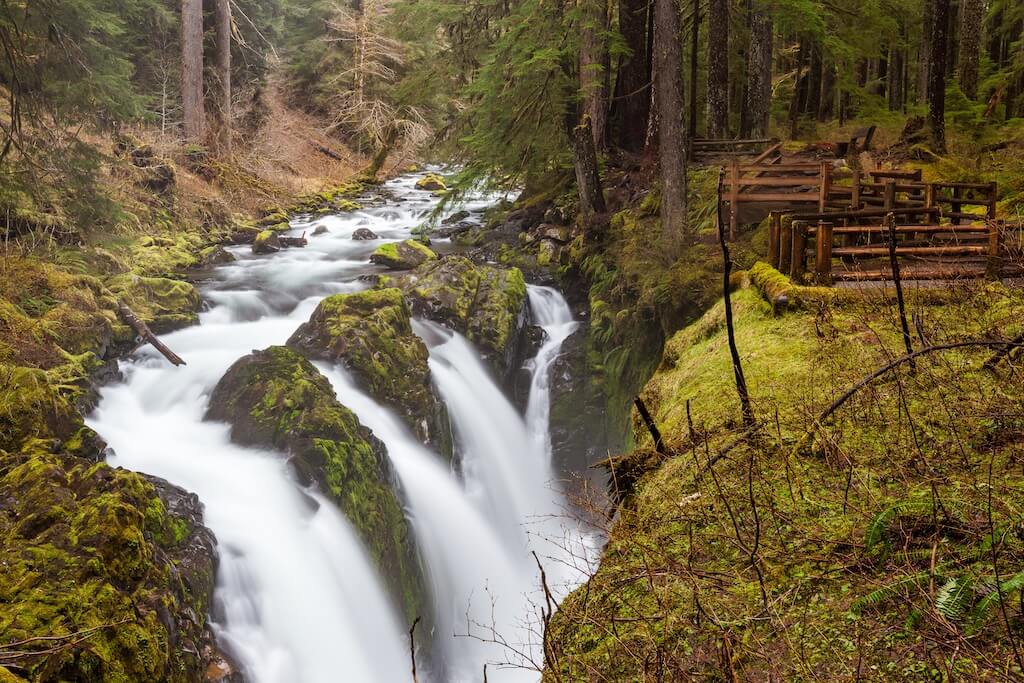
There are over 611 miles of hiking trails in this Washington park and you will find a trail for every skill level and hiker. One of my personal favorite easy hike sis the one to Sol Duc Falls; the 1.6-mile hike leads hikers to one of the most iconic sites in the park.
If you’re a more advanced hiker, you will love the Klahhane Ridge Trail which leads you 6.8 miles to Lake Angeles.
Most travelers opt to visit Olympic National Park in summer, but don’t write it off in winter!
While many of the park’s usual offerings are closed in winter, you can still venture through the magical and mysterious Hoh Rainforest with far fewer crowds.
Check price and availability of places to stay in Port Angeles, near Olympic National Park here.
Megan | MeganStarr.com
10. Bryce Canyon National Park for Hoodoos
No advance timed entry reservations are required at Bryce. Expect high traffic though and full parking lots by mid-morning during peak seasons.
I’ve seen Bryce under snow and in all its spring glory and it never fails to disappoint!
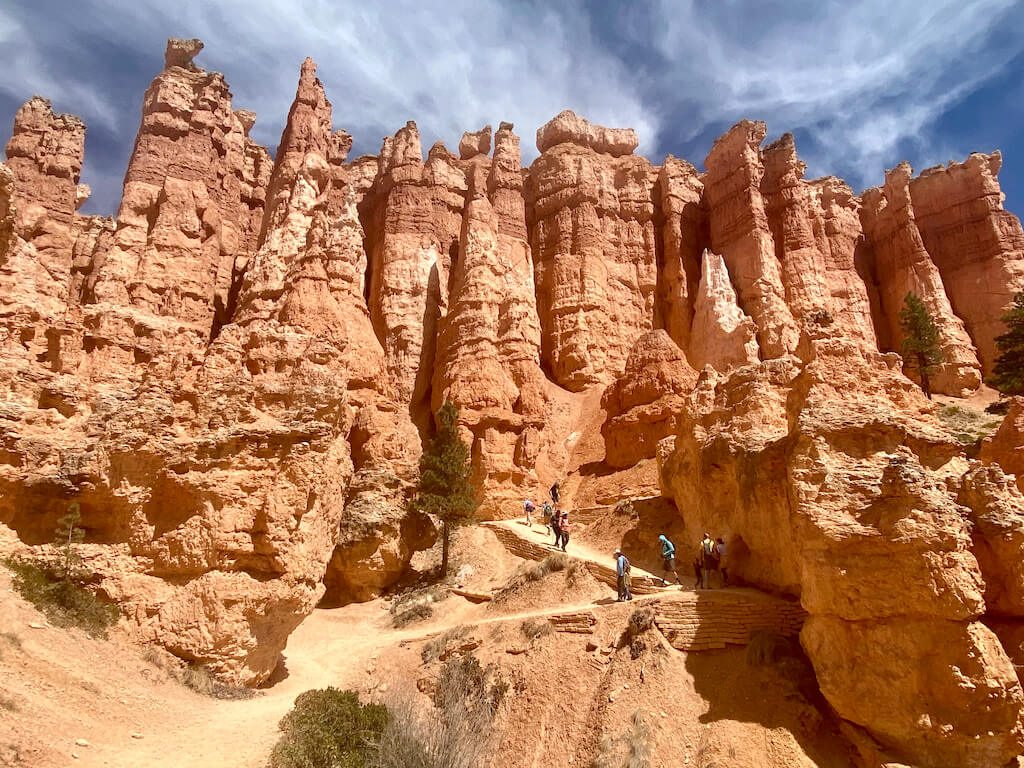
Bryce Canyon National Park is home to thousands of hoodoos—irregular-shaped stone columns or pillars formed from erosion. When crowded together, they create an incredible, alien-like landscape.
On my visits, I like to see the hoodoos from above on the Rim Trail and then venture down into them on a hike.
The biggest concentration of hoodoos is in the large bowl-shaped Bryce Canyon Amphitheater. This is where the main park facilities are located and where the best views are.
There are plenty of viewpoints, including the appropriately named Sunrise Point and Sunset Point, as well as Inspiration Point and Bryce Point.
The most popular of the great hikes in Bryce Canyon is the Queen’s Garden – Navajo Loop Trail. This 3-mile trail takes you past many of the most famous hoodoos and is well worth the effort. (It’s a steep climb in and out of the canyon!)
If you’re not much of a hiker, another way to enjoy the hoodoos is the Rainbow Point drive. This 17-mile drive takes you along the rim of the entire canyon, with multiple turnoffs to enjoy the views.
In addition to the national park lodging, there is a small village just outside the park with accommodations, restaurants, and, in summer, a western dinner show that is fun to watch.
Check price and availability on places to stay near Bryce here.
James | Parks Collecting
11. Death Valley National Park for a Technicolor Desert
No advance reservations are required for Death Valley. However, you’ll need a reservation for some campgrounds and special backcountry permits.
Death Valley is the largest national park in the lower 48 states. It’s the hottest, lowest, and driest place in North America. Triple-digit temperatures lasting for months are common.
Our favorites? The enigmatic landscapes of Death Valley at Devil’s Golf Course, Racetrack Playa, and the Bad Water Basin (the lowest point in North America). We loved learning how animals that live here have adapted to the harsh environment.
One of the prettiest hikes in Death Valley that we adored is Golden Canyon.
Most recently, Death Valley made headlines as the hottest place on earth when it hit 130°F in August of 2020.
The record was set in 1930 with a high of 134°F; however, this fact is now often questioned, as experts say that thermometer readings were not as accurate as today.
While you might want to wait for temperatures to cool down and save your trip for late fall and winter, visiting the hottest place on the planet definitely should be on your US bucket list! (Death Vally is a great place to visit in California in January.)
Entry to Death Valley costs $35, and if you plan to visit other national parks in the region, such as Yosemite or Sequoia, I recommend purchasing an America The Beautiful National Parks Pass.
Death Valley is four hours away from LA and under two hours from Las Vegas. That makes it a perfect spot if you plan a longer West Coast road trip.
Check price and availability on places to stay in Pahrump near the park here.
Daria | The Discovery Nut
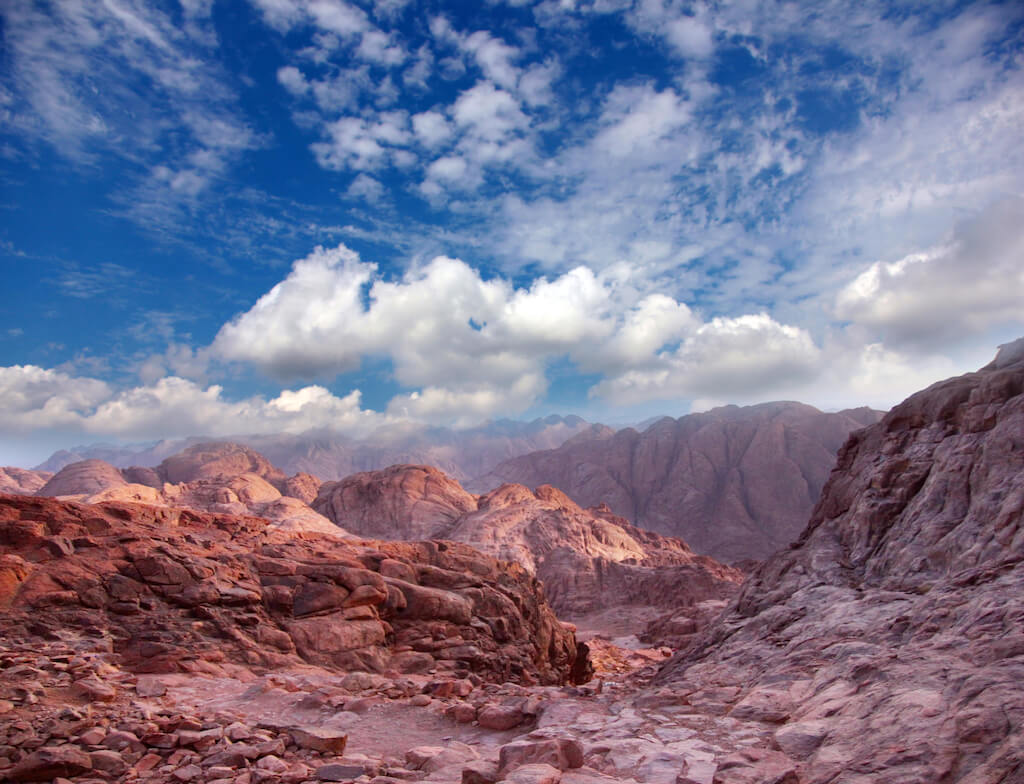
12. Joshua Tree National Park for a Desert Escape
No advance reservations are required for Joshua Tree but be aware as popular camping spots fill quickly in peak season (October to May).
If you are vacationing in Southern California, Joshua Tree National Park is a spectacular spot to add to your itinerary.
Located near Palm Springs, it is easily accessible and a perfect place to explore for a day.
Joshua Tree is a unique national park in that it contains two different ecosystems within the park. The northern end of the park overlaps with the Mojave Desert, which is at a slightly higher elevation. This area contains many of the Joshua Trees the park is named after.
The southern part of the park is considered the Colorado Desert. Here, visitors can see more yucca and cholla cactus.
Joshua Tree officially became a National Park in 1994 and contains 790,000 acres of land, just slightly smaller than the state of Rhode Island.
It’s best to avoid visiting the park in the summer months as it can get extremely hot in the desert.
During our visit, we hiked Barker Dam, where we saw tons of Joshua Trees, and the Cholla Cactus Garden. Skull Rock is also a great stop.
If interested in a longer hike, take the 4-mile loop to the Lost Horse Mine. Visitors can see a preserved mill from the gold rush days.
The 90-minute Keys Ranch tour is a good option if you don’t want to hike.
Check price and availability on the 18 best places to stay in Joshua Tree here.
Francesca | Homeroom Travel
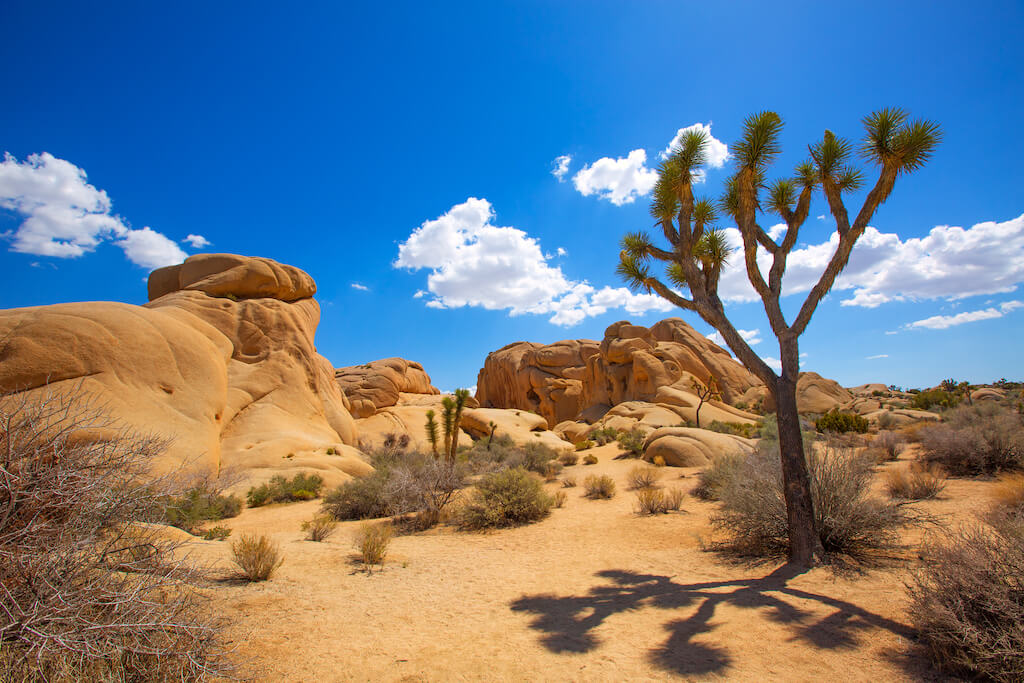
13. Rocky Mountain National Park for Wildlife
Rocky Mountain National park is one national park where advance timed entry reservations are still required mid-May to mid-October. You can book the Bearl Lake Road corridor or one for the rest of the park.
Located just about an hour and a half northwest of Denver, Rocky Mountain National Park is known for its incredible wildlife spotting opportunities, sparkling mountain lakes, excellent hiking, and beautiful scenic drives. (Aspen, Colorado—just a few hours away—is also fantastic for fall hikes.)
We based in nearby Estes Park on our visit after a fall wedding and loved seeing the elk and hearing them bugle! The park was absolutely decked out in fall colors.
Some of the best hikes in Rocky Mountain National Park include the Emerald Lake trail to Nymph Lake, Dream Lake, and Emerald Lake—a very high-reward hike for only about four miles round-trip—and the ever-popular Bear Lake.
More challenging options include Sky Pond and Chasm Lake trails.
Hiking isn’t the only way to explore the Rockies, though. The park’s scenic drives, including the famous Trail Ridge Road and Fall River Road, offer absolutely magnificent views without the need for hiking.
While the most popular time to visit is the summer (by a landslide), this is a year-round national park. Spring is also a great time to visit for smaller crowds and better accommodation prices.
If you’d like to try snowshoeing around Bear Lake, watching the elk rutting season from a safe distance, or enjoying the best of spring wildflowers, you’ll always find a reason to visit Rocky Mountain National Park.
Check price and availability on stays near Rocky Mountain National Park here.
Kate | Our Escape Clause
14. North Cascades National Park for Mountain Scenery
Advance reservations are strongly recommended and often required for camping in North Cascades. All drive-in campgrounds in summer and overnight backcountry stays year-round require permits.
Lesser known than many big-name parks but cherished by locals, North Cascades National Park in northern Washington State offers some of the most spectacular mountain scenery anywhere in the USA.
In fact, North Cascades in October is particularly dazzling with the autumn foliage of larches and deciduous pine trees, which turn gold in the fall.
With an impressive line of sharp peaks and an uncommonly remote feel, this is the place to go for alpine hiking without the crowds.
Despite being just a two hour drive from Seattle, North Cascades is lightly trafficked. The vast majority of casual hikers stick to the more accessible highlights in Olympic and Mount Rainier National Parks.
Highway 20, the main road through the park, is quiet enough that it actually closes in winter.
This amazing road journey features incredible scenery and charming little mountain towns such as Marblemount and Newhalem. It’s an essential part of any great Pacific Northwest road trip.
Ross and Diablo Lakes are postcard-worthy scenic gems. Colonial Creek Campground, on south Diablo, is truly one of the most beautiful campgrounds in a state full of them.
In addition to views out over the serene glassy lake directly from your tent, the terrific Thunder Knob and Thunder Creek hikes both start right from the campground.
There are many other great hikes in the area, including highlight trails such as Cascade Pass and Desolation Peak.
Keep in mind, though, that if hiking is your main focus, you should wait until at least July when most of the snow will be gone.
If you won’t be camping, check prices and availability on places to stay near North Cascades here.
Dean and Laynni | Routinely Nomadic
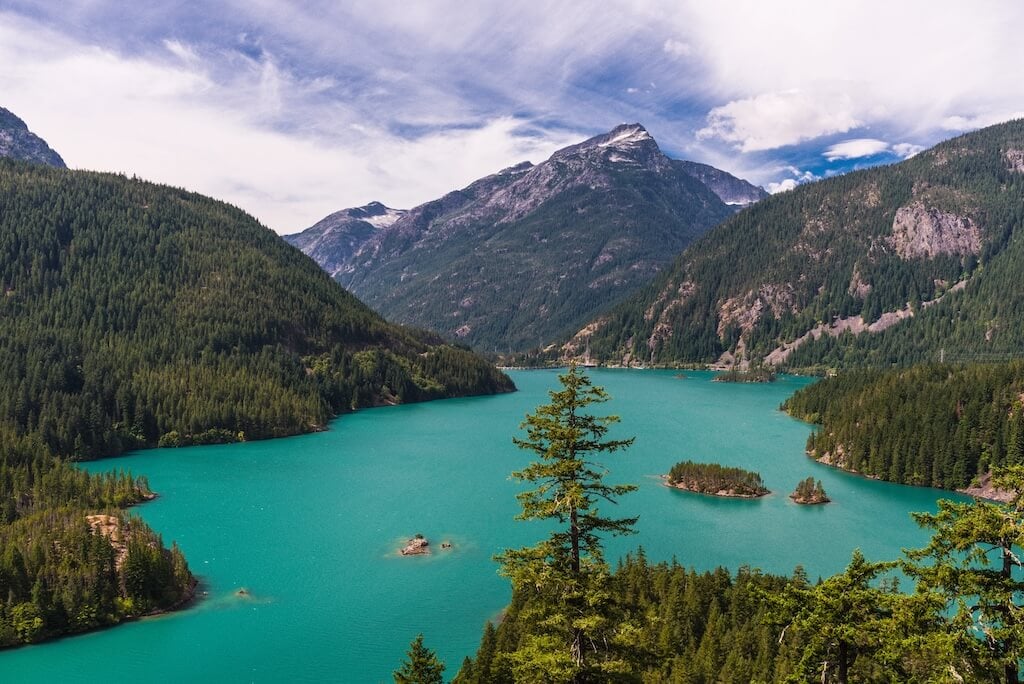
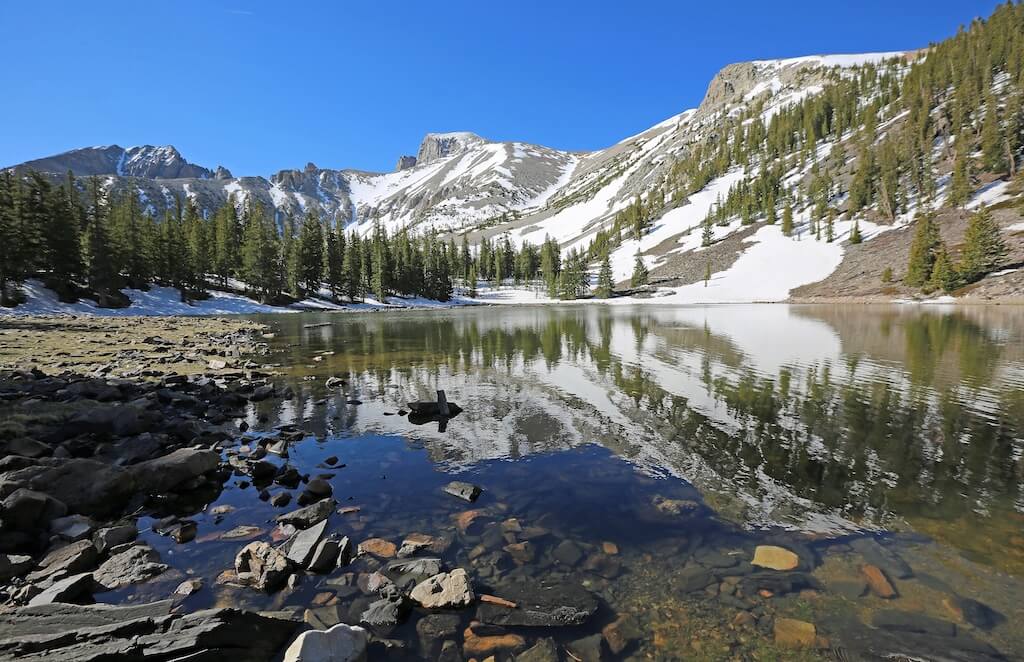
15. Sequoia National Park for Giant Redwoods
No timed entry permits are required for Sequoia National Park.
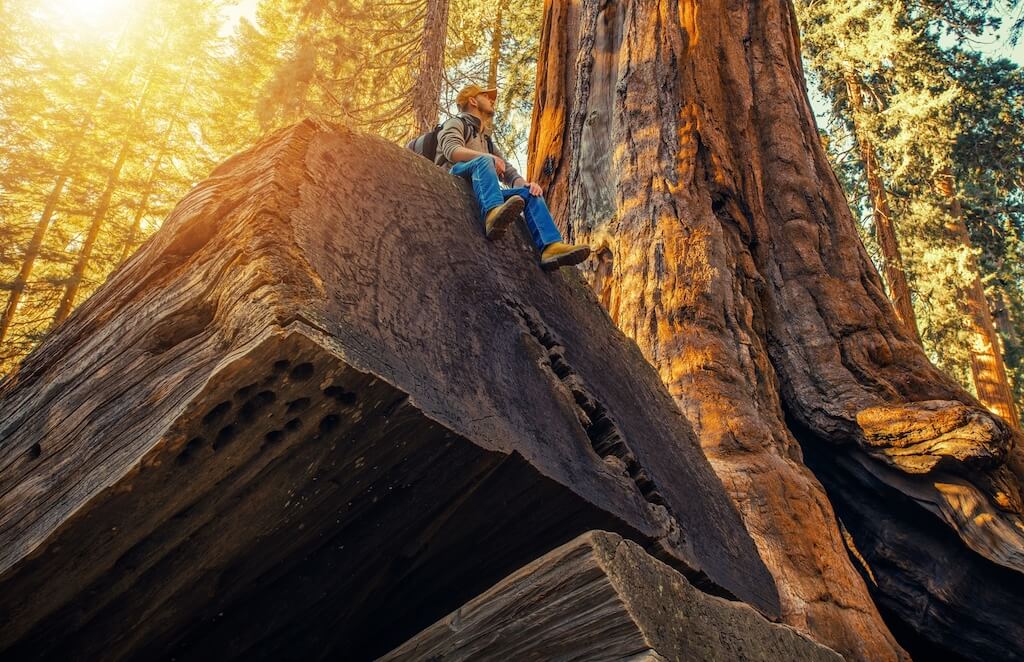
Have you ever seen a giant Sequoia tree? Although redwoods grow taller, for overall size, sequoias are the largest trees in the world. And that’s the draw for this park.
In fact, you’ll find the biggest tree on earth here: the General Sherman Tree, which can be reached along a paved path from a nearby parking lot.
At one point, the trail goes through a tunnel cut through the trunk of a giant tree that fell across it.
The General Sherman Tree is the start of the Congress Trail, a three-mile easy loop past many other enormous named trees.
Other highlights include the Chief Sequoya Tree and the President Tree. Although the trees tend to grow alone, there are also two small groves (called the House and the Senate).
We were awestruck standing among a collection of these giants!
There are plenty of other trails in the park to enjoy,t oo, including the Big Trees Trail, which circles a meadow that is a popular place to see wildlife such as black bears in the late afternoon.
Don’t miss a visit to the Giant Forest Museum, which has interesting displays about the trees.
The adjacent Kings Canyon National Park also has sequoias, including the Grant Grove, home to the third largest tree on earth, the General Grant Tree.
Check prices and availability for places to stay near Sequoia/Kings Canyon here.
James | Parks Collecting

16. Crater Lake National Park for a Volcanic Lake
No timed entry permits are required for Crater Lake. Be aware the north entrance closes November 1 until late May.
Crater Lake National Park may be Oregon’s only national park, but it is mighty and more than deserves its national park status!
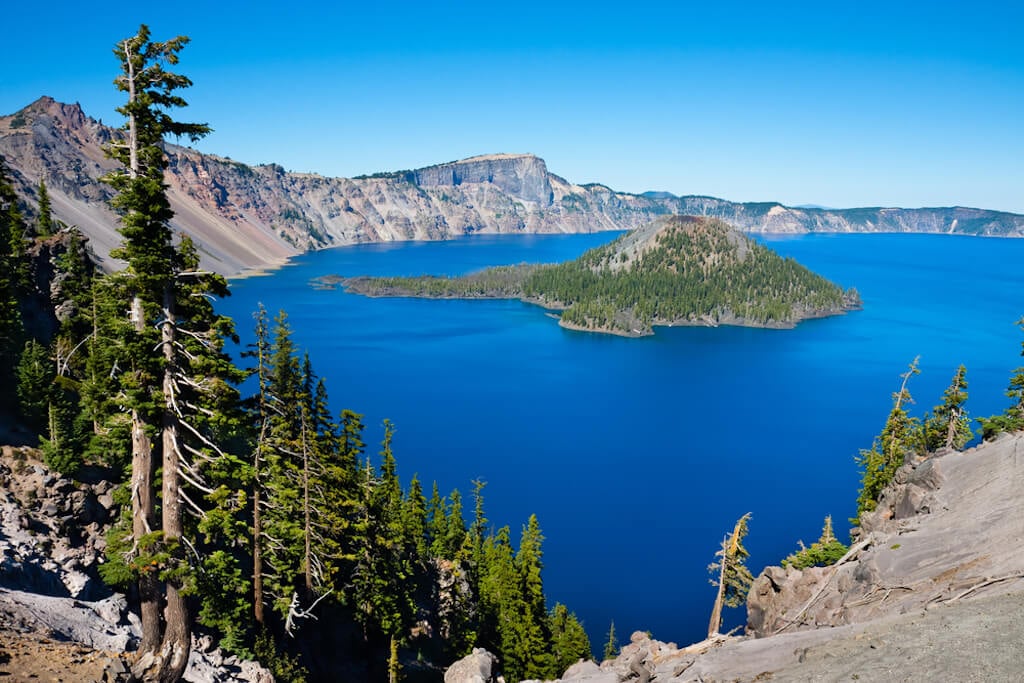
Crater Lake is the deepest lake in the entire United States, a lake nestled in the remnants of a volcano that formed a caldera after the eruption of Mount Mazuma nearly 8,000 years ago.
The lake is nearly 2,000 feet deep, and the water’s clarity is astounding. You can view over 100 feet deep into its colors from the water’s surface.
There are several worthwhile things to do in Crater Lake National Park but any trip should start with a drive circumnavigating the caldera via Rim Drive.
This beautiful 33-mile drive takes a little over an hour to complete, but when you factor in photo stops, it can easily take up to half a day.
There are 15 designated view points. Two favorites are Watchman Overlook and Cloudcap Overlook (the latter is a favorite sunset spot).
You should also take a boat trip to Wizard Island, one of two islets in Crater Lake, and hike in the vicinity.
Beginner hikers will enjoy the easy stroll to Plaikni Falls, whereas more experienced hikers will enjoy climbing Crater Peak, a seven-mile roundtrip summit hike.
Check price and availability on places to stay near Crater Lake here.
Allison | Small Town Washington
17. Arches National Park for Natural Arches
Timed entry requirements have been lifted for Arches in 2026. Be aware that this is a small park that seems more than 1.5 million visitors per year though. Arrive very early to beat the crowds.
One of the most unique landscapes you’ll find in all of Utah is in Arches National Park. This park is known for, well, its arches.
There are over 2,000 documented arches in the park, and even more in the surrounding area!
According to the National Park Service, Arches has the highest concentration of natural arches in one place in the world. It seems like there is another arch everywhere you look!
The most famous is Delicate Arch, an arch that requires a 3-mile roundtrip hike.
It’s not a particularly difficult hike, but if you’re visiting in summer, you’ll want to go either at sunrise or sunset to avoid the worst of the heat (and the crowds).
Be sure to bring a headlamp!
Other worthwhile natural arches to add to your Arches National Park itinerary include Double Arch, the Windows, Turret Arch, and Skyline Arch.
But there are so many more that you could visit! Those are just the most famous ones.
Our other favorite places to see in Arches National Park include Devil’s Garden (an epic 2-mile hike where you’ll pass a dozen or so arches), the hoodoos of Fiery Furnace, Petrified Dunes Viewpoint, and the Moab Fault Overlook.
Check prices and availability on places to stay in Moab near Arches here.
Allison | Eternal Arrival
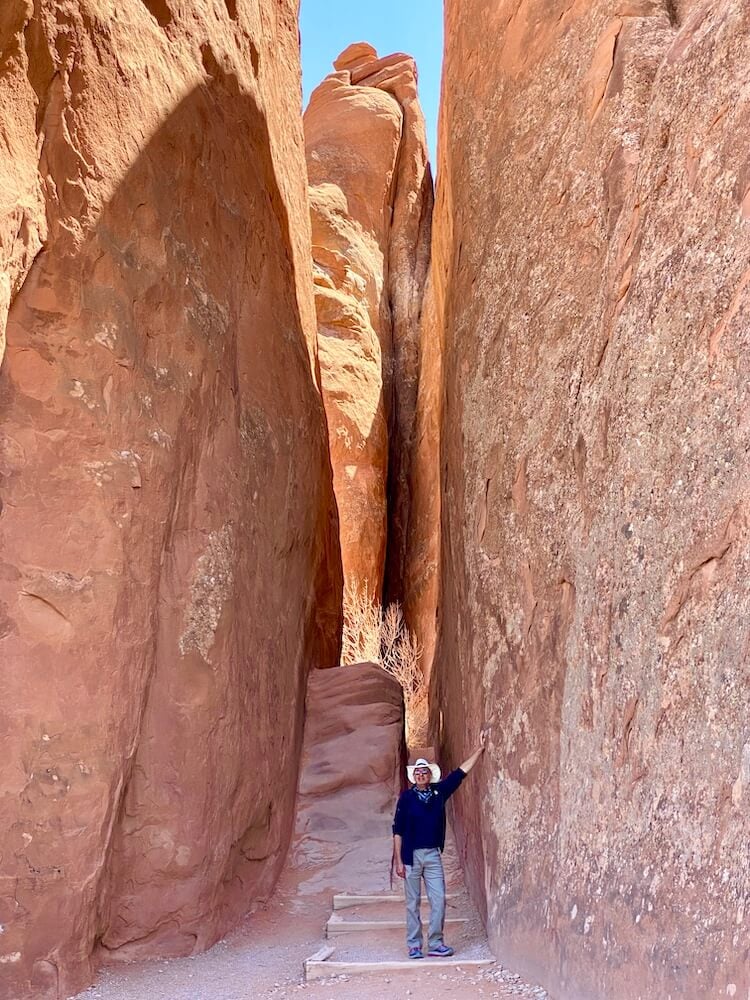
18. Mount Rainier National Park for Waterfalls and Wildflowers
Mt. Rainier will also not require timed entry reservations any longer. However, it’s also a very small park which means that various strategies will be used to manage congestion. That could include closing areas deemed to be full. Consider a weekday visit, exploring lesser known trails or visiting early in the morning or late afternoon.
Due to its year-round snow-capped peaks and proximity to its namesake 14,410-foot active volcano that towers over 369 square miles of protected federal land, Mount Rainier National Park is one of the most spectacular and diverse national parks on the West Coast.
A single hiking trail can begin in the pine forest, take you to the base of a rushing river, to the top of a towering waterfall, and onto a prairie of blooming flowers for some of the most picturesque views of that towering 14,410-foot Mount Rainier in the backdrop.
And those features aren’t just found on a single trail!
Since the national park is centered around Mount Rainier, you can see the mighty mountain from nearly anywhere in the park.
Some of the best hikes are the reflecting lakes of Tipsoo Lake and Reflection Lake trails, the pine-forested Grove of the Patriarchs Trail, the snow-covered Skyline Trail, and the panoramic stunner Fremont Fire Lookout Trail.
While hiking is at its peak inside the park from April to September, the best time to visit is from late July to early August. (Be prepared for serious wind and rain though, even in August. We found the temps were much cooler than at the base of the mountain.)
Due to its unique and cold climate, the park’s host of colorful flora typically begins blooming during that timespan. That’s when places like Paradise Valley really come alive.
Check prices and availability on places to stay near Mount Rainier here.
Jarrod | Ramble around the World

19. Pinnacles National Park for California Condors
Timed entry permits are not required to enter Pinnacles. Be aware there is no shuttle service between the East and West entrances. Parking lots fill up in spring and fall by 8 am or earlier!
Located just two hours south of San Francisco, Pinnacles National Park is a beautiful park to visit and explore. It makes a great Bay Area getaway.
It is the smallest and newest national park in California, having just received its designation in 2013.
Pinnacles gets its name from the beautiful, towering rock formations that jut from the landscape, formed by a volcano more than 20 million years ago.
Today, the park boasts more than 30 miles of hiking trails, so you can explore the rocks as well as caves, chaparral, fields, forests, and beautiful wildflowers in the springtime.
Many of the hiking trails intersect, allowing you to customize the length and difficulty level of your hike.
In addition to hiking, Pinnacles National Park is a great place for wildlife viewing.
The park’s most sought-after resident is the California Condor, with its magnificent nine-foot wingspan. Other native species include turkey vultures, hawks, bats, kangaroo rats, and golden eagles.
Note: The park has two entrances—one to the west and one to the east—and they aren’t connected by roads.
The west side of Pinnacles National Park is more remote and popular with day trippers looking to hike or rock climb.
The east side offers more services and is home to the park’s pool and campground, but tends to get a lot busier!
In fact, plan to arrive early if you are visiting the east side for the day; parking fills up early and you’ll have to walk or take a shuttle to get to the main trailheads otherwise.
Check prices and availability on places to stay near Pinnacles here.
Gwen | California Family Travel
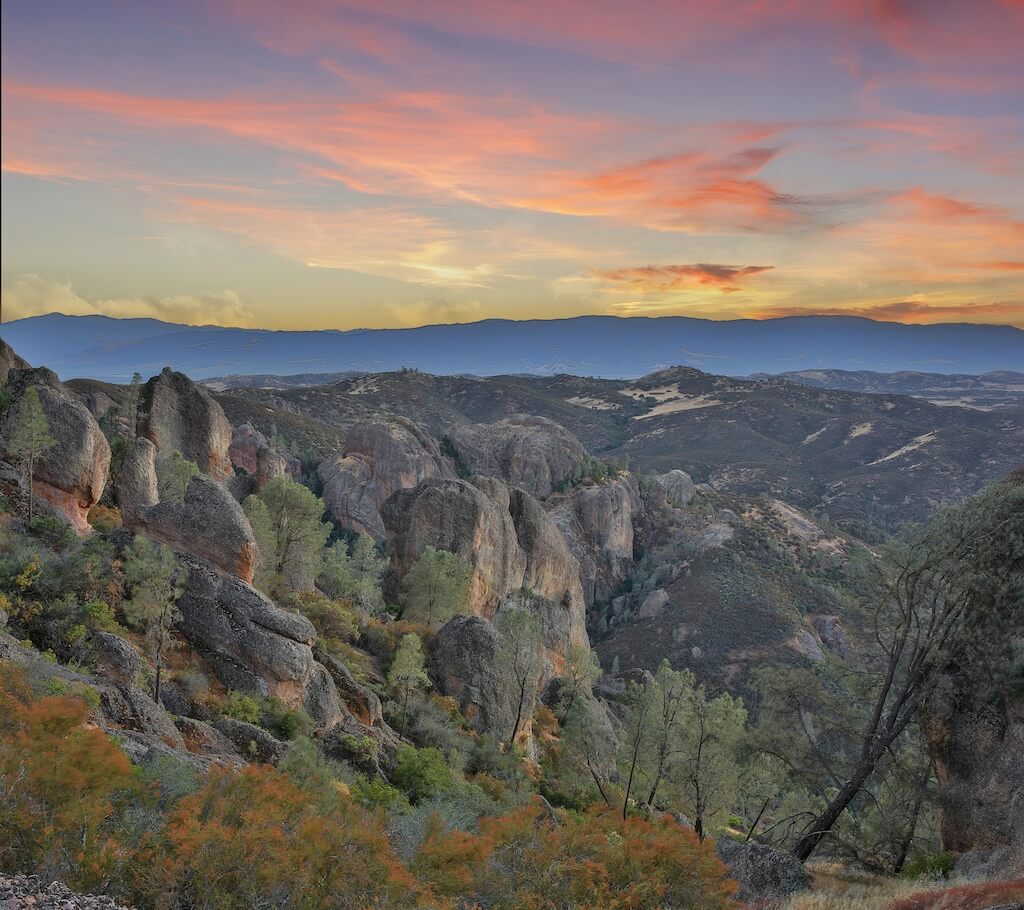
20. Capitol Reef National Park for Red Rock Cliffs
No timed entry permits or advanced reservations are required to enter Capitol Reef.
Capitol Reef National Park is one of the least visited of Utah’s national parks, which makes it a fabulous place to beat the crowds. It’s named after the white rounded dome resembling the U.S. Capitol building.
On our visit to the Mighty Five, it was also one of my very favorite parks. While many visitors take a quick drive through the park, it’s a spectacular hiking destination…well worth a visit of several days.
Be sure to visit the historic town of Fruita in the middle of the park. (Best pie I’ve ever had was here!) Fruita is named after the Mormon Latter-Day Saints and other early settlers here who farmed apples, pears, and peaches.
You’ll also see petroglyphs by the Fremont culture (settlers for 1,000 years here) in the park. Look for them all along Utah State Route 24. Bring binoculars!
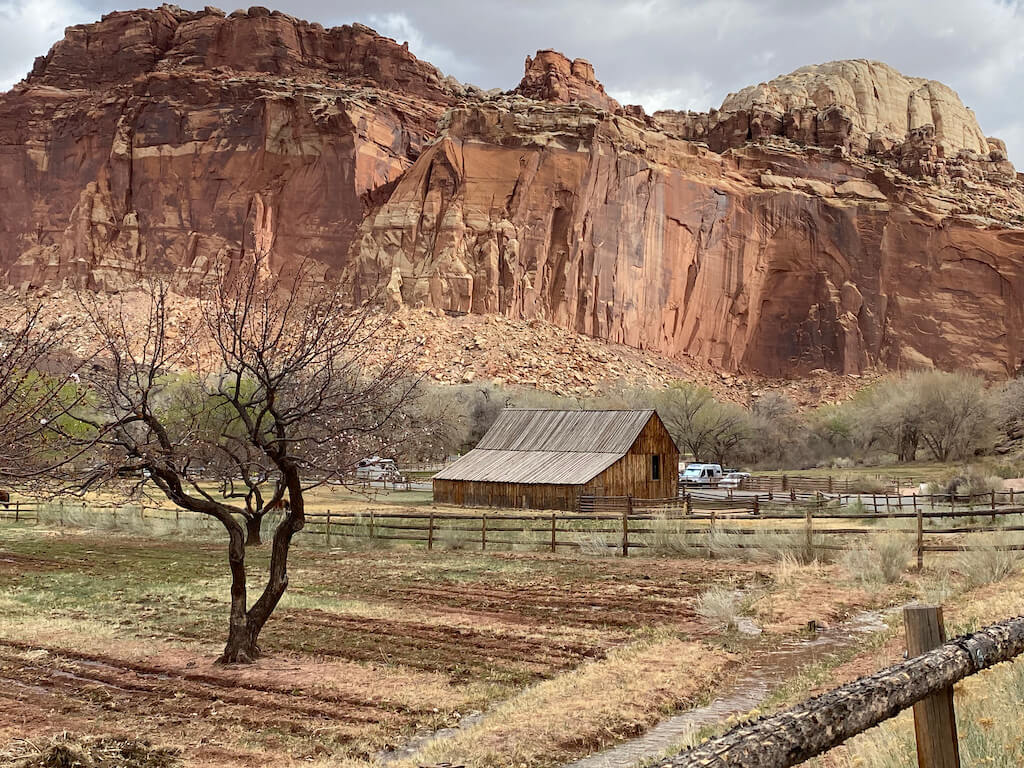
21. Redwood National Park Old Growth Coastal Redwoods
Timed entry permits are not required to enter Redwood National and State parks. However, free day-use parking reservations are required mid-May to mid-September for Fern Canyon/Gold Bluffs Beach and year-round for the Tall Trees Grove.
Redwood National Park, established in 1968, is managed as a group along with three state parks in Humboldt County, California, and is technically known as Redwood National and State Parks (RNSP).
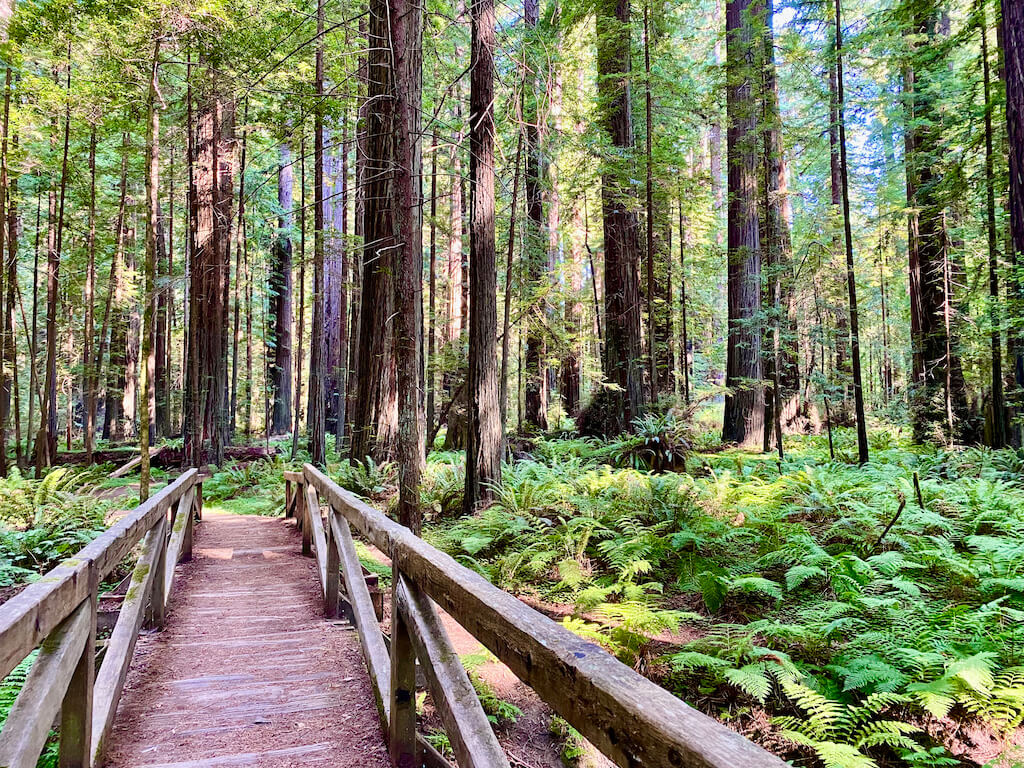
Together, the park protects nearly half of old-growth coastal redwood trees. It’s a magical place and gives travelers a glimpse of what it must have been like to walk through a pristine prehistoric forest.
Be sure to exit off US101 on the coast and head inland north of Orick along the Newton B. Drury Scenic Parkway. It’s a memorable drive with giant coastal redwoods stretching to the sky along both sides of the highway.
Once in the park, be sure to take a short walk through the Lady Bird Johnson Grove.
This short 1.5-mile flat loop is dedicated to Lady Bird Johnson who promoted the protection of natural habits like this one during her time as First Lady. Massive redwoods abound here.
With more time, hike the Boy Scout Tree Trail (3 to 5 hours) or the Stout Memorial Grove Trail (1 to 2 hours).
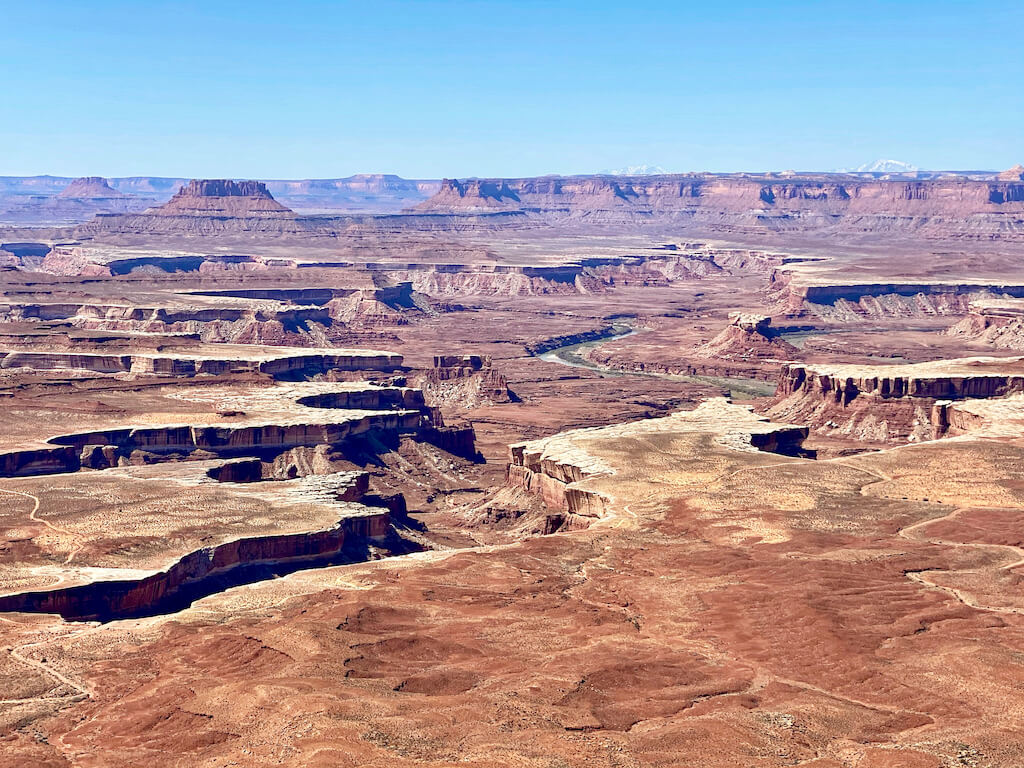
22. Canyonlands National Park for Amazing Geology
No timed entry permits are required for Canyonlands, unless you want to do a river trip, backcountry camping or access certain 4×4 roads for day use.
Canyonlands is another lesser-known of the western national parks but totally worth your time! It’s an easy day trip from Moab (a makes a great base to see Arches as well).
It’s important to know that Canyonlands is huge and sprawling. There are four areas: Island in the Sky, the Needles, the Maze, and the Rivers.
While each of these areas is hours from each other by car, it’s easy to get to Island in the Sky where you can tour the mesa in a 34-mile round-trip scenic drive.
There’s no gas or food in these parts so plan ahead. The landscape here is like no other. It feels like a desolate barren desert. And yet, the deeply carved canyons and vast mesas are absolutely breathtaking.
Plan on a full day touring Island in the Sky as a day trip from Moab or far more time to see all four areas.
Another great day trip is to spend half a day at nearby Dead Horse State Park as we did (get here for sunrise) and the other half at Canyonlands.
23. Lassen Volcanic National Park for a Hydrothermal Wonderland
Lassen does not currently require timed entry permits for park access. Camping and backcountry wilderness permits are required for overnight stays.
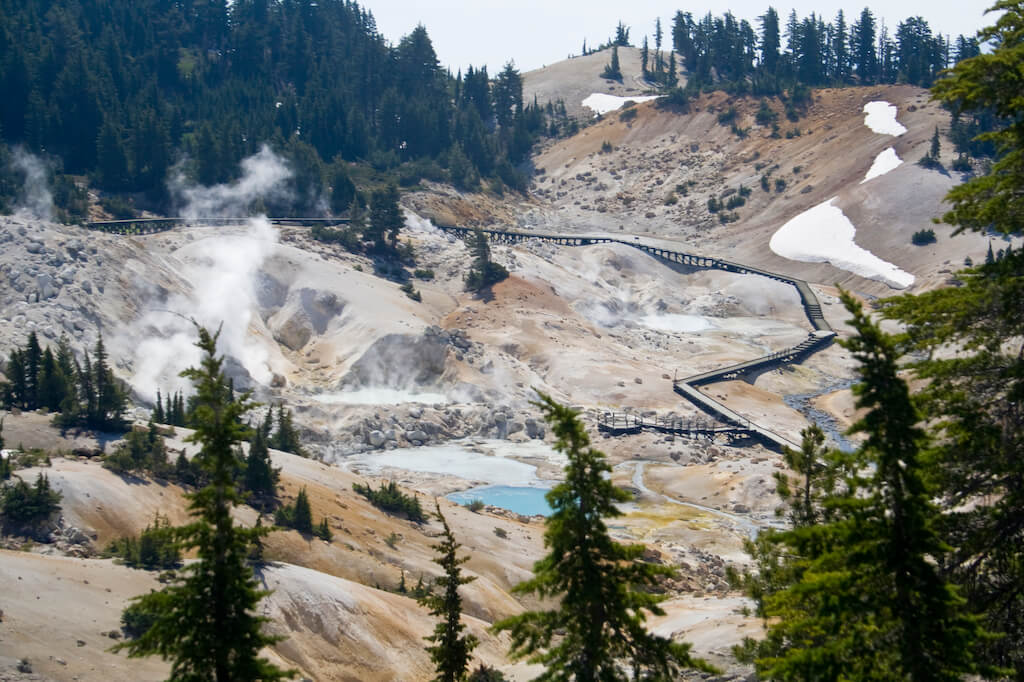
Lassen Volcanic National Park in northern California draws visitors with its rich hydrothermal areas, meadows of wildflowers, and gorgeous lakes.
Lassen Peak—the largest plug dome volcano in the world—is a highlight here. In fact, Lassen is one of the few places where you can see all four kinds of volcanos: plug dome, cinder cone, shield, and stratovolcano!
Be sure to explore Manzanita Lake during your visit. (Cabins and campgrounds abound in this area.)
Then head out on Bumpass Hell Trail in Lassen’s largest hypothermal area. It’s an easy three-mile hike but offers eye-popping views of deep blue pools and boiling mud pots.
The easy Manzanita Lake Loop trail will give you great views of the surrounding peaks reflected in the placid lake waters.
Best of all, Lassen is dark sky country for astounding stargazing. The Dark Sky Festival is held here every August.
24. Mesa Verde National Park for UNESCO Cliff Dwellings
No timed entry permits are required for Mesa Verde. Ranger-guided tour tickets are required though to enter most cliff dwellings. They are released 14 days in advance and sell out quickly!
Mesa Verde National Park in the southwestern corner of Colorado is a sacred place and UNESCO World Heritage Site.
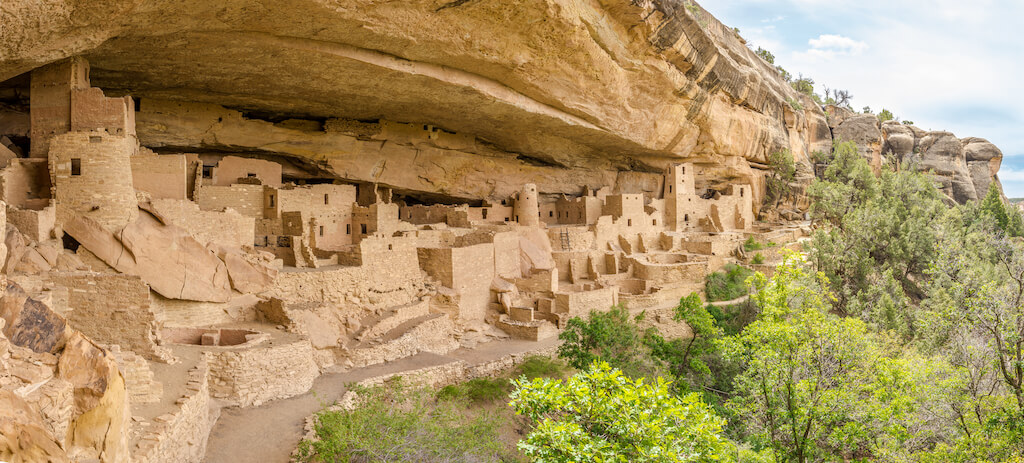
Native Pueblo peoples lived here for over 700 years, and Mesa Verde is the largest archaeological preserve in the USA. You’ll find more than 5,000 sites here, including 600 cliff dwellings where Ancestral Puebloans made their home.
The Cliff Palace is particularly striking. It’s a beautiful structure carved into the side of a cliff, made out of sandstone, mortar, and wooden beams.
As you tour this cliff dwelling, you’ll note that the doors seem small here; that’s because the average man was under 5 feet six inches when these dwellings were built!
Be sure to stop at the Chapin Mesa Archaeological Museum while you’re here for a peek into Mesa Verde’s history.
Then take the 2.4-mile Petroglyph Point Trail to see petroglyphs. It’s near the museum.
25. Kings Canyon National Park for Towering Granite Peaks
Timed entry permits are not required to enter Kings Canyon. However, reservations are required for caming, lodging, and cave tours.
You’ll find majestic Kings Canyon in central California, adjacent to Sequoia National Park, so it’s no surprise you’ll find plenty of giant Sequoia trees here.
In fact, Kings Canyon is home to Redwood Canyon, which is the largest grove of sequoia trees in the world!
You’ll find miles of hiking trails, horseback riding, and places to camp here in this magnificent glaciated valley.
Be sure to take the short trail in Grant Grove to see the 1700-year-old General Grant Tree (the only tree that can compete with General Sherman in Sequoia National Park).
Then take the scenic drive in Zumwalt Meadow past evergreen forests and towering granite peaks. See Mist Falls and Boyden Cavern.
26. Great Basin National Park for Dark Skies
There are no timed entry permits required for Great Basin. Reservations are strongly recommended however for Lehman Cave tours, as they sell out fast during peak season.
Located in southeastern Nevada, just west of the Nevada-Utah border, Great Basin National Park can be a little harder to reach than other popular parks, but it’s diverse and beautiful!
Not only will you find some of the darkest skies here in the USA for stargazing but Great Basin National Park is also known for its groves of ancient bristlecone pines.
The most popular thing to do at Great Basin is to tour the Lehman Caves with a ranger. You’ll learn all about the history, geology, and ecology of these incredible historic caves.
This dramatic cave system is millions of years old! But book your tour ahead as space fills fast.
Then take the 12-mile scenic Wheeler Peak Scenic Drive up the mountain with stops at Mather Overlook and Wheeler Peak Overlook.
Alpine Lakes Loop Trail makes an easy 2.7-mile hike with a big payoff. Don’t miss the viewpoints at Stell and Teresa Lakes!
Pin it for later!

Thanks for this list of West Coast USA National Parks! We have traveled to many of them with our RV and enjoy hiking trails & meadows to get up close & personal with each park. But you have listed some we have not thought about going to, so we will try to include them this next year when we take a 6 week RV trip from AZ to Colorado, then over to the coast before heading south again.
That sounds like a lovely plan for 2021, Sigrid! I’ll be taking my first RV trip myself this year and really looking forward to it.
This is a great list. There are so many great west coast parks. We were most surprised by Pinnacles and Lassen. Those are two we didn’t expect to be so amazing.
I love Lassen! And Pinnacles is so lesser known.
Are there must see must ride scenic railways In Southwest and west
Likewise. Are there parks and scenic railways In Colorado. that should be on a bucket list? Iwould like a sample itinerary
Hi Jean, I’m aware of a couple in Colorado. Check out the Durango & Silverton Narrow Guage Railroad for a historic steam train ride. There is also one through the southwest from the Rockies to the Red Rocks…Denver to Moab via Arches Nat’l Park or continuing to Las Vegas via Capitol Reef, Bryce, and Zion parks. You can learn more about all these parks on my post about the Mighty Five parks in Utah here although this is a road trip vs train itinerary. Check out “Canyon Spirit” for more on this route by train!